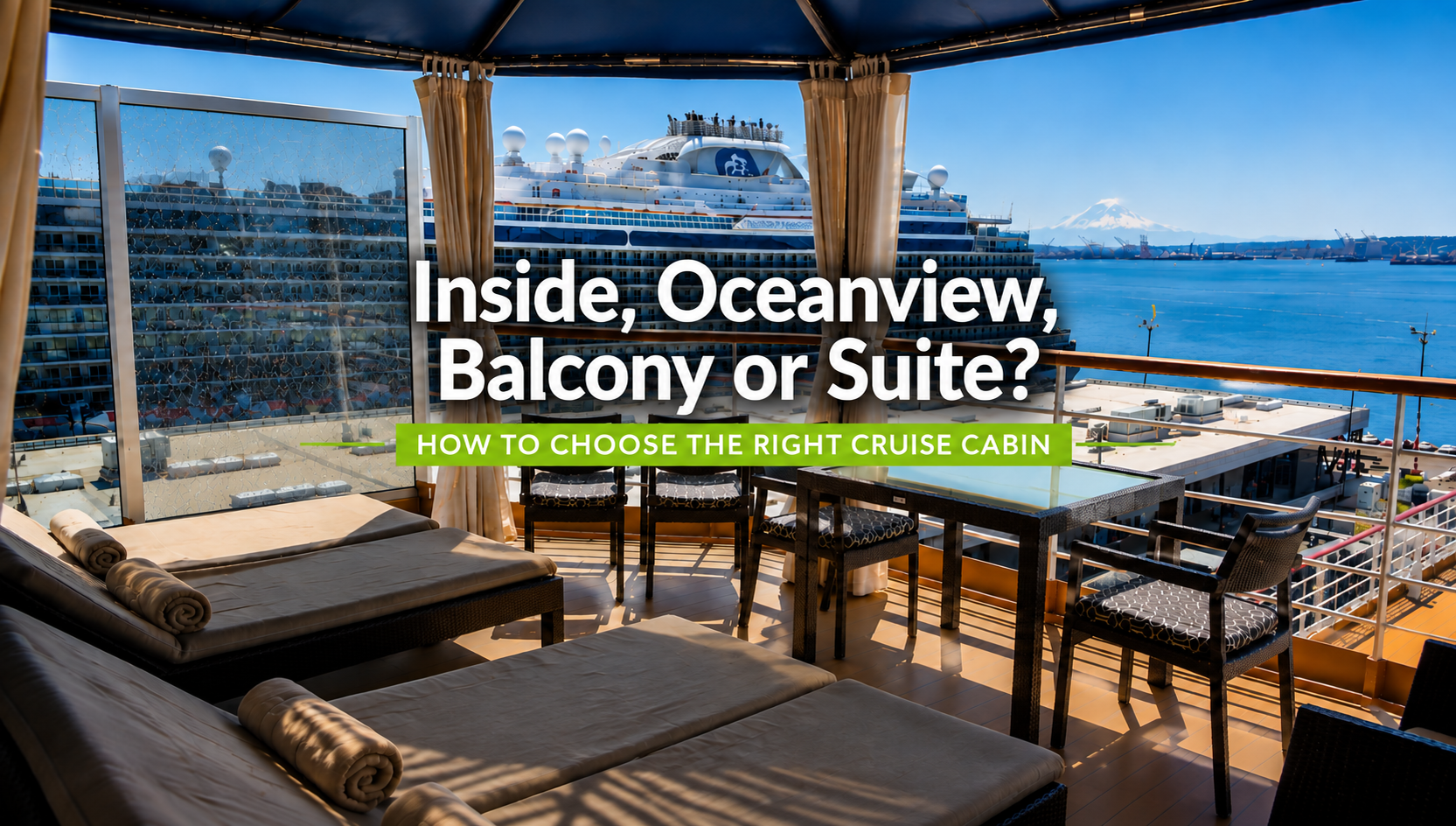
Inside, Oceanview, Balcony or Suite?
How to Choose the Right Cruise Cabin
By Jim Hoover, Cruise Planners Travel Advisor
Choosing your cruise is exciting. You’ve picked an itinerary, found a ship you love, and started imagining all the places you’ll visit.
Then you get to the next question:
Which cabin should I book?
Inside, oceanview, balcony, suite—and then seemingly endless categories within each one. For a first-time cruiser, it can get confusing quickly.
The good news is that there really isn’t one “best” cabin for everyone. The right choice depends on your budget, itinerary, how much time you expect to spend in your cabin, and what matters most to you while you’re on vacation.
But there’s another factor that is just as important and often overlooked: where your cabin is located on the ship.
Two cabins in the exact same category—and sometimes at the exact same price—can provide very different experiences depending on what’s above, below, and next to them.
1. Inside Cabins: Best for Value
Inside cabins are typically the least expensive accommodations on a cruise ship. They don’t have a window or balcony, but otherwise you’ll generally have everything you need: a bed, bathroom, storage, television, and a comfortable place to relax at the end of the day.
For travelers who plan to spend most of their time exploring the ship, enjoying activities, or visiting ports, an inside cabin can be a great way to cruise for less.
The biggest tradeoff is the lack of natural light. When the lights are off, an inside cabin can be very dark—which some people absolutely love for sleeping.
Some newer ships also offer inside cabins with virtual windows or balconies that display an exterior view. They don’t replace the real thing, but they can make the room feel more open.
2. Oceanview Cabins: Natural Light Without the Balcony Price
An oceanview cabin gives you a real window to the outside world without the added cost of a balcony.
Depending on the ship, that window might be a small porthole, a traditional picture window, or a much larger panoramic window.
Oceanview cabins can be a nice middle ground for travelers who want natural light and the ability to see outside but don’t expect to spend much time sitting on a private balcony.
Lifeboats, ship structures, equipment, or other features can partially or completely obstruct some windows. These cabins may be priced lower, so they can actually be a good value—as long as you know what you’re getting before you book.
3. Balcony Cabins: Is the Upgrade Worth It?
For many cruisers, a balcony is where the cruise experience starts to feel a little special.
Open the door in the morning and step outside with a cup of coffee. Watch the ship pull into port. Sit outside with a book in the afternoon. Enjoy the sunset before dinner.
And on scenic itineraries, the balcony itself can become part of the destination.
Alaska is a perfect example. Sailing past mountains, waterfalls and glaciers from your own private balcony can be an incredible experience.
But does everyone need one? Not necessarily.
If your cruise is extremely port-intensive and you’re ashore from morning until evening, you may spend surprisingly little time in your cabin. If you’re someone who wants to be out enjoying the pools, restaurants, entertainment and activities whenever you’re onboard, an inside or oceanview cabin might make more sense.
4. Suites: More Than Just a Bigger Cabin
Suites can offer significantly more space, but depending on the cruise line and ship, the benefits may extend well beyond square footage.
- A larger cabin and balcony
- Separate living and sleeping areas
- Larger or upgraded bathrooms
- Priority embarkation and disembarkation
- Concierge or butler service
- Access to private lounges, restaurants, pools, or sun decks
- Priority reservations
- Additional dining or beverage benefits
The exact benefits vary considerably between cruise lines—and even between different suite categories on the same ship.
That’s why it’s important to look at what comes with the suite, rather than simply comparing its size to a standard cabin.
5. A Ship Within a Ship
One of the most interesting developments in cruising is the “ship within a ship” concept offered on some of today’s larger cruise ships.
And it can completely change the experience of sailing on a big ship.
Imagine having access to all the amenities of a large resort-style cruise ship—multiple restaurants, Broadway-style entertainment, pools, water parks, casinos, shopping, activities and nightlife—but being able to retreat to a much smaller and more intimate area reserved for suite guests.
Depending on the ship and cruise line, these exclusive areas may have their own restaurant, lounge, bar, pool, sun deck, concierge, dedicated staff and priority services.
A Small-Ship Feel on a Big Ship
It’s almost like having a small ship tucked inside a big one. You can enjoy all of the restaurants, shows, nightlife, activities and amenities of the larger ship, then retreat to a quieter and more intimate environment when you’re ready to relax.
For travelers who love the atmosphere and personalized service of a smaller ship but don’t want to give up the entertainment, restaurants and activities available on today’s largest ships, this can offer something pretty special.
The amenities of a big ship with the feel of a small ship.
On ships offering a true ship-within-a-ship experience, you may be purchasing an entirely different type of cruise vacation—not simply a bigger room.
6. Location, Location, Location
Here’s where cabin selection gets really interesting.
You can choose the perfect cabin category and still end up unhappy if you don’t pay attention to where that cabin is located.
Before booking, look at the ship’s deck plan.
Then look at it again.
And don’t just look at your deck. Look at the decks above and below you, too.
Forward, Midship or Aft?
Forward is toward the front of the ship, midship is around the middle, and aft is toward the back.
Midship cabins are popular because they’re centrally located and generally experience less noticeable movement than cabins toward the bow or stern.
Forward cabins can be convenient for venues located toward the front of the ship, but movement may be more noticeable in rough seas.
Aft cabins can offer spectacular wake views, and some ships have highly desirable oversized aft balconies. But they may require longer walks to reach venues at the opposite end of the ship.
But there’s something important to consider: wind.
When a cruise ship is underway, a forward-facing balcony can be exposed to significantly more wind than a balcony along the side or back of the ship. Depending on the ship’s speed and weather conditions, that can make the balcony much less comfortable to use while you’re at sea.
If relaxing outside is one of the main reasons you’re paying extra for a balcony, make sure you understand how exposed that particular balcony may be before booking.
7. What’s Above and Below Your Cabin?
This may be one of the most important pieces of advice in this entire guide.
Before selecting a cabin, look at the deck immediately above it and the deck immediately below it.
A cabin with other cabins above and below is generally a safer choice if quiet is important to you.
Be more cautious if your cabin is directly below or above:
- The pool deck
- Fitness center
- Nightclub
- Theater
- Restaurant or galley
- Sports court
- Kids’ club
- Busy public area
- Crew or service area
A cabin underneath the pool deck may look perfectly fine on your deck plan—until deck chairs start moving around early in the morning.
Likewise, a cabin over a nightclub might not be ideal if your idea of nightlife is being asleep by 10:30.
But remember that if your bid is accepted, you may lose the ability to choose where your new cabin is located.
I once had a client successfully upgrade to a spa suite, which sounded like a fantastic upgrade. Unfortunately, their new cabin was located right next to the weight room in the fitness center.
Every morning they woke up to the loud thuds of people using and dropping free weights.
Before bidding on an upgrade, make sure you’re comfortable giving up control over your cabin location. Sometimes the cabin you carefully selected is better than an “upgrade” in a less-than-ideal location.
8. Should You Book Near an Elevator?
Some travelers automatically avoid cabins near elevators because they’re worried about noise. But don’t dismiss them too quickly.
Being reasonably close to an elevator or stairwell can be extremely convenient, especially on today’s larger ships. It can save a surprising amount of walking over the course of a week.
The key is looking at the actual deck layout. A cabin near an elevator lobby isn’t necessarily the same thing as a cabin directly exposed to a heavily traveled public area.
9. Port or Starboard: Does It Really Matter?
Port is the left side of the ship when facing forward. Starboard is the right.
People frequently ask which side is better.
For most cruises, there isn’t a universally better side.
Ships may dock facing different directions in different ports, and docking arrangements can change. A cabin that faces the harbor on one sailing might face away from it on another.
There are certain itineraries and ports, however, where knowing how the ship normally docks can help you choose.
MSC ships typically dock with the starboard side facing Ocean Cay, making a starboard-side cabin a great choice if you’d like to look out over the island from your room or balcony.
Prefer a view looking away from the island and out across the water? Consider a port-side cabin instead.
It’s a great example of why there isn’t always one “best” side of a cruise ship. Sometimes it simply comes down to which view you’d rather wake up to.
Docking arrangements can change because of weather or operational conditions, so consider this a helpful guideline rather than a guarantee.
10. Traveling With Family or Friends?
Connecting cabins can be fantastic for families and groups traveling together.
You get separate sleeping areas and bathrooms while still having convenient access between rooms.
Some balcony cabins also have partitions that can be opened between neighboring balconies, although policies vary by ship.
But if you don’t need a connecting cabin, you may prefer a standard cabin. The connecting door can sometimes allow more sound to travel between neighboring rooms.
One Big Cabin or Two Smaller Ones?
If you’re traveling with children or another couple, don’t automatically assume one larger cabin is the best choice.
Sometimes two neighboring or connecting cabins make more sense. And there’s one very good reason: two bathrooms.
Anyone who has tried getting four people showered and ready for dinner at the same time will understand why that can be a pretty significant cruise amenity.
Before booking a larger family cabin or suite, compare its cost with two cabins. You might be surprised.
11. A Word About Accessible Cabins
Accessible cabins are designed for guests who need specific mobility and accessibility features. They may include wider doorways, accessible bathrooms, additional maneuvering space, ramps, and other specialized features.
Because these cabins are limited in number and designed for travelers who need them, they shouldn’t simply be viewed as a way to get a larger cabin.
If someone in your party has accessibility requirements, this is another area where planning early can be especially important.
12. Guaranteed Cabins: A Great Price With a Tradeoff
You may encounter something called a guarantee cabin, often abbreviated GTY.
Instead of choosing a specific cabin number, you’re guaranteed a certain category or minimum category, and the cruise line assigns your actual cabin later.
The attraction is usually price.
The tradeoff is control.
You might end up with a terrific cabin. You might even receive a higher category. But you could also end up in a location you wouldn’t have chosen yourself.
13. Which Cruise Cabin Should You Choose?
Best for Value
- Inside: Lowest price
- Oceanview: Natural light without balcony pricing
- GTY: Possible savings if location doesn’t matter
Best for the Experience
- Balcony: Private outdoor space
- Suite: Extra space and amenities
- Ship within a ship: Big-ship amenities with a smaller-ship feel
If motion is your biggest concern…
Look for a cabin lower and closer to midship.
If quiet is your biggest concern…
Choose a cabin with other cabins above and below you.
If scenic cruising is a priority…
A balcony cabin can be well worth the upgrade, especially on itineraries such as Alaska.
If cabin location really matters to you…
Choose a specific cabin rather than leaving the assignment to the cruise line.
14. The “Best” Cabin Isn’t Always the Most Expensive
One of the biggest misconceptions about cruising is that spending more automatically means you’ll have a better cabin experience.
No—and that’s an important point.
A well-located oceanview cabin might be a better choice for you than a poorly located balcony.
A carefully selected balcony might be preferable to a suite next to a noisy public space.
And an inside cabin might allow you to spend your vacation budget on the experiences you care about most.
Think about how you actually cruise. Are you going to spend hours on your balcony, or will you be out exploring the ship? Are you a light sleeper? Are you worried about motion? Is the itinerary scenic? Do you want the amenities of a large ship but a quieter, smaller-ship atmosphere?
The best cruise cabin is the one that fits the way you like to travel.
Ready to Find the Right Cruise Cabin?
Choosing a cabin involves much more than deciding between inside, oceanview, balcony, or suite.
Where the cabin is located, what’s above and below it, how much motion you may feel, what views you want, and what amenities come with your cabin can all make a difference.
Jim and Christine Hoover at Vacay Dreams can help you compare ships, itineraries, cabin categories, deck locations, and suite benefits so you’re not simply booking a cruise cabin—you’re choosing the right cabin for your vacation.
Contact Jim & ChristineBecause a great cruise starts with the right ship—but the right cabin can make it even better.


One thought on “”